
Packaging Industry
Cutting machines are used for carton, paper cup, blister packaging, wooden lunch boxes and foam packaging materials, helping manufacturers achieve efficient production.
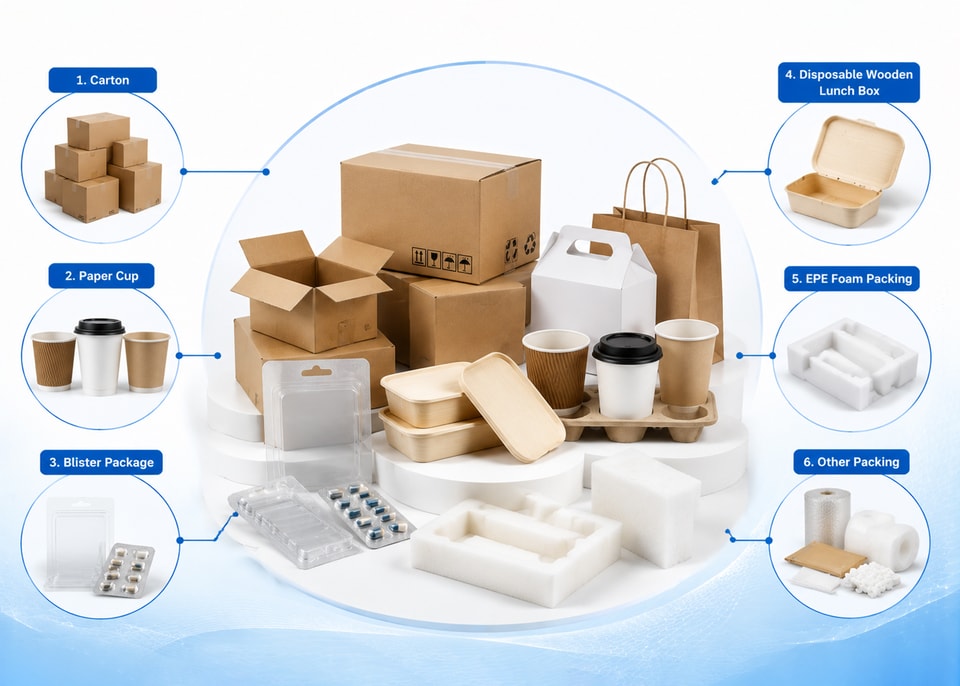
Automatic cutting machines are foundational to the packaging industry, where materials range from rigid paperboard and corrugated cardboard to flexible films, foams, and metallic laminates. Their applications span primary packaging (cartons, blister packs), secondary packaging (corrugated boxes, displays), and protective packaging (foam inserts, bubble wrap), delivering precision, speed, and material efficiency across diverse product formats.
For paperboard and corrugated cardboard (folding cartons, rigid boxes, and shipping containers), CNC-driven flatbed die-cutters and rotary die-cutting systems are the industry workhorses. Flatbed machines process stacked sheets (up to 10mm thick) with steel-rule dies, achieving speeds of 50–80 strokes per minute for folding cartons, with tolerances of ±0.15mm essential for high-speed automatic packaging lines. Rotary die-cutters handle continuous corrugated rolls at speeds exceeding 200 meters per minute, producing slotted boxes, pizza cartons, and retail displays. Advanced models incorporate automatic creasing and scoring attachments for precise folding lines, and perforating wheels for tear-open features. Laser cutting systems are increasingly used for short-run custom packaging, eliminating expensive steel dies and enabling rapid design iteration. CO₂ lasers cut intricate windows, handles, and decorative cutouts with micron-level precision (±0.05mm), while simultaneously sealing the cut edges to prevent fiber delamination—critical for luxury cosmetic and confectionery packaging.
For corrugated packaging with printed graphics, vision-guided cutting systems read registration marks to ensure perfect alignment between cuts and printed designs, eliminating off-center windows or misaligned fold lines. Automated nesting software optimizes part layout on the sheet, achieving material utilization rates of 85–95% for complex multi-component packaging kits, substantially reducing paperboard waste.
For protective packaging, automatic cutting machines process expanded polyethylene (EPE) foam, polyethylene (PE) foam, and expanded polypropylene (EPP) for cushioning inserts. CNC hot-wire cutters and reciprocating knife systems transform large foam buns into precision-fit inserts for electronics, medical devices, and glassware, achieving dimensional tolerances of ±0.5mm. Multi-axis contour cutting creates complex 3D cavities, stepped tiers, and chamfered edges for optimal product nestling. Ultrasonic cutting technology is preferred for cross-linked polyethylene foams, as the 20–40 kHz vibration simultaneously cuts and slightly fuses the cut surface, preventing foam particle shedding—a critical requirement for cleanroom and medical device packaging. For anti-static ESD foams used in electronics packaging, laser cutting systems provide contamination-free, precision-cut pockets with zero physical contact, protecting sensitive components from electrostatic damage. For honeycomb paperboard and corrugated cardboard inserts, oscillating knife cutters process multiple layers (up to 30mm stacks) into custom divider configurations, with automatic waste stripping and stacking modules ensuring continuous production.
For aluminum foil packaging (including blister pack lidding foil, pharmaceutical strip packaging, and food container seals), automatic cutting systems employ precision rotary die-cutting and laser slitting. Rotary dies with etched blades process thin aluminum laminates (0.02–0.10mm) at speeds exceeding 300 m/min, producing exact cavity cutouts, peel tabs, and perforations for easy-open features. Fiber laser cutters are increasingly utilized for intricate foil patterns and micro-perforations (down to 0.2mm diameter) used in breathable food packaging and controlled-release pharmaceutical foils. The non-contact nature of laser cutting eliminates tool wear and ensures burr-free, clean-cut edges, critical for maintaining the foil's moisture and oxygen barrier properties. Integrated tension control systems prevent foil wrinkling or tearing during high-speed conversion.
For corrugated box inner partitions and dividers, slotter-scorer combiners with multiple rotary tooling stations process thick corrugated sheets (up to 7mm) into complex interlocking structures. Automatic feed and stacking systems enable production rates of 15–20 complete divider sets per minute, with simultaneous slotting, scoring, and corner-cutting operations. Vision systems verify cut slot widths (typically 3–6mm) to ensure tight fit with product corners.
For shrink films, stretch films, and flexible pouches, slitter-rewinders and bag-making cutters process polyolefin, PVC, and polyester films. Servo-driven systems continuously unwind, cut, and seal films into individual bag lengths at speeds up to 250 bags per minute. Integrated ultrasonic welding and hot-knife sealing attachments simultaneously cut and form seals, ensuring hermetic closures. For stand-up pouches and spout pouches, automatic rotary cutters shape the film into bag preforms with zipper tracks, slits, and notches precisely positioned within ±0.3mm.
For foil-lined paper and composite laminates (used in cosmetic sachets and pharmaceutical cold-form blisters), waterjet and laser hybrid systems are employed. Waterjets cleanly cut through the aluminum layer without heat-induced delamination, while lasers seal the paper-foil interface at the cut edge, preventing layer separation during pouch forming and filling. This combined approach achieves burr-free edges and maintains barrier integrity.
Finally, all these automatic cutting systems are integrated with Industry 4.0 smart platforms, featuring automatic tool libraries, robotic material handling, and real-time quality monitoring via laser profilometry. Automatic blanking and stacking modules sort finished components (carton blanks, foam inserts, foil seals) directly into pallets or packaging bins, minimizing manual handling. Predictive maintenance algorithms monitor blade wear, motor load, and vibration, scheduling tool changes before dimensional drift occurs, reducing downtime by up to 35%. Automated dust and fume extraction systems with HEPA and carbon filtration handle paper dust, foam particles, and potential volatile emissions from film cutting, ensuring a safe and clean manufacturing environment.
Collectively, these technologies deliver significant economic and operational benefits: material savings of 15–30% through optimized nesting, labor reduction of 40–60%, and production speed increases of 50–200% compared to manual cutting. The ability to switch rapidly between die, laser, waterjet, and ultrasonic modes also enables packaging manufacturers to accommodate short-run custom orders, seasonal packaging changes, and diverse material portfolios—from ultra-thin foils to heavy-duty corrugated—all within a single automated platform, meeting the ever-evolving demands of the global packaging industry.
Contact Us


