
How Does a Four-Column Structure Improve Cutting Stability?
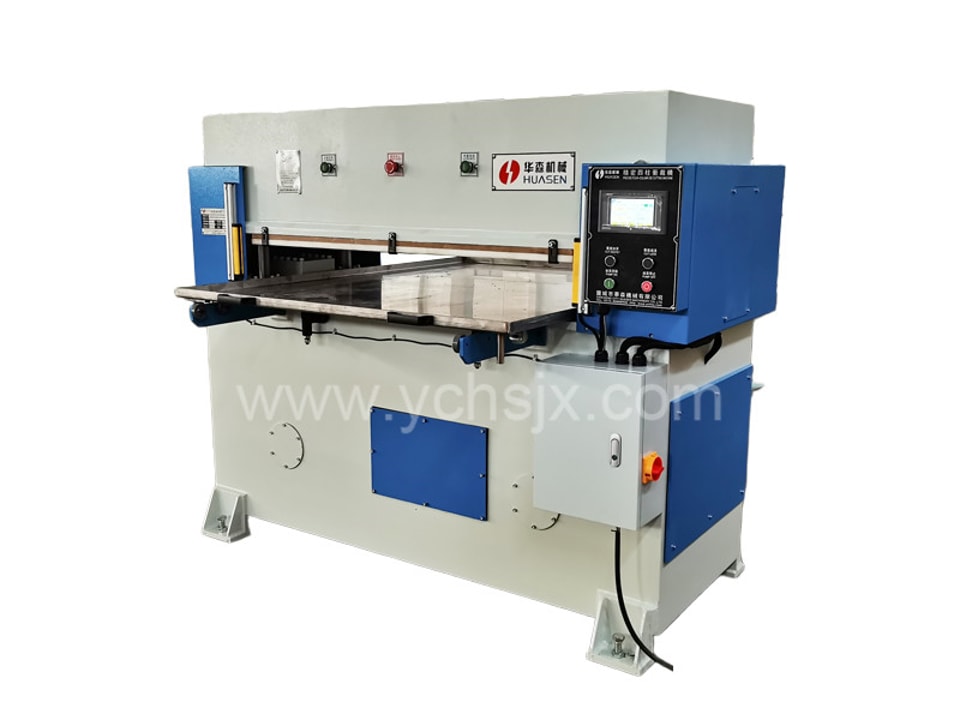
The four-post structure is a key design feature that distinguishes the four-post cutting machine from other cutting equipment. This structure utilizes four precision guide posts to support and guide the upper platen, ensuring stable movement during the cutting process.
In industrial production, cutting stability directly impacts dimensional accuracy, processing efficiency, and material utilization. With advantages such as uniform force distribution, precise guidance, and high-rigidity support, the four-post structure effectively enhances overall equipment performance, meeting the demands of various materials and high-precision processing.
I. Four-post guidance ensures smooth movement
During the cutting process, the upper platen undergoes a reciprocating vertical motion. If the guidance system is inadequate, issues such as misalignment or tilting can occur, leading to uneven force on the cutting die and compromising the cutting quality.
The four-post structure establishes a stable path of motion via its four guide posts, ensuring the upper platen moves strictly vertically. Even under high pressure, it minimizes positional deviation and enhances the stability of the cutting process.
II. Uniform pressure distribution improves cutting results
The uniformity of pressure distribution during cutting directly affects the quality of the processed material.
Equipment with conventional structures may experience localized pressure concentration, resulting in incomplete cuts or material deformation in certain areas. In contrast, the four-post structure distributes pressure more evenly across the work area, ensuring consistent force application across the entire cutting die.
Uniform pressure output ensures a clean, complete cut and improves edge smoothness, making it ideal for high-precision processing requirements.
III. Enhanced structural rigidity reduces operational vibration
Industrial equipment often operates continuously for extended periods; insufficient structural rigidity can lead to vibration and positional drift.
The four-post structure employs a multi-point support system, boosting the equipment's overall stability. During high-speed, continuous cutting, it minimizes mechanical oscillation and maintains optimal operating conditions.
High structural rigidity not only improves cutting stability but also helps extend the equipment's service life.
IV. Improved capability for processing large-area materials
Large-format materials often require a wide cutting area, placing higher demands on equipment stability.
The four-post structure effectively supports large work areas, ensuring that pressure is evenly distributed across the entire cutting zone. When processing large-scale products made of leather, foam, or composite materials, the four-column structure minimizes processing errors caused by uneven force distribution, thereby enhancing overall cutting quality.
Ⅴ. Ensuring Precise Die Positioning
The accuracy of the cutting die's position is a critical factor influencing cutting results.
The four-column guide structure minimizes deviation during the movement of the upper platen, ensuring the cutting die maintains a stable operating path.
Precise positioning capabilities improve dimensional consistency, making the system particularly suitable for high-volume production scenarios requiring repetitive processing.
Ⅵ. Adapting to Diverse Material Processing Needs
Different materials—varying in hardness, thickness, and elasticity—impose distinct requirements on cutting stability.
For instance, leather requires precision cutting, foam necessitates deformation prevention, and rubber demands sufficient pressure to ensure a clean cut. The four-column structure provides stable pressure transmission, allowing the equipment to easily adapt to processing a wide range of materials.
By adjusting pressure parameters and swapping cutting dies, the equipment can meet diverse production requirements.
Ⅶ. Minimizing Processing Errors and Boosting Production Efficiency
A stable cutting process reduces defect rates and cuts down on the time required for rework and manual finishing.
The four-column structure ensures consistency in every cutting stroke, standardizing the production process.
For mass-production enterprises, stable processing quality not only enhances efficiency but also lowers overall production costs.
8. Enhancing Long-Term Operational Reliability
Industrial equipment often operates in demanding environments characterized by long hours and high-intensity workloads. Thanks to its optimized force distribution, the four-column structure prevents individual components from bearing excessive stress.
Over the long term, this stable structural design helps maintain equipment precision and mitigates performance degradation caused by structural deformation.
Conclusion
The four-column structure utilizes four guide pillars to provide precise guidance and stable support, ensuring superior stability during the cutting machine's operation.
Its key advantages include smooth movement, uniform pressure, high structural rigidity, precise positioning, and broad material adaptability. In industrial settings requiring high-efficiency and high-precision cutting, the four-column structure effectively improves processing quality, ensures product consistency, and provides a reliable foundation for stable, long-term production.
Contact Us


