
Consumer Products
Cutting machines provide reliable processing solutions for mouse pads, keyboard pads, screen protector films and other consumer products, ensuring accurate shapes and smooth edges.
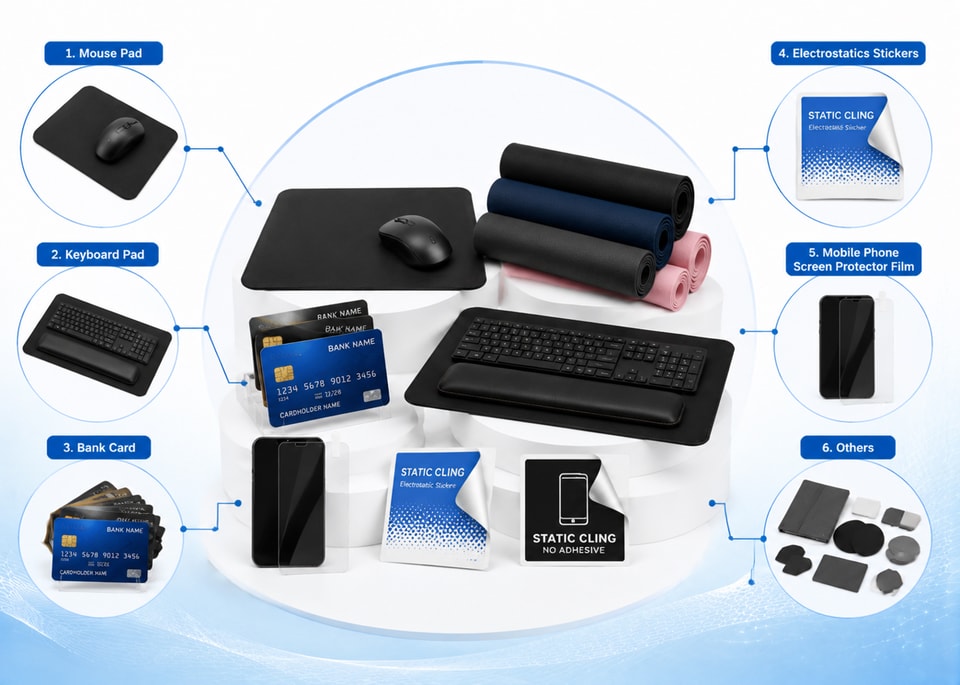
Automatic cutting machines are fundamental to the mouse pad manufacturing industry, where materials range from soft textiles to rigid composites, and where precision, edge quality, and high-volume throughput are paramount. Their applications cover every component of a mouse pad, from the surface layer to the anti-slip base, enabling both budget-friendly mass production and premium gaming-grade products.
For the surface fabrics and textiles—including polyester cloth, nylon spandex, microfiber, Cordura, and specialized speed or control weaves—CNC-controlled oscillating knife and reciprocating blade cutting systems are the standard. These machines process single or multiple layers (typically 5–20 sheets stacked) with high precision, achieving edge tolerances of ±0.3mm. For high-end gaming mouse pads with printed graphics, vision systems equipped with CCD cameras read registration marks on the fabric to ensure the cut pattern perfectly aligns with the printed artwork, preventing off-center designs. Ultrasonic cutting technology is increasingly adopted for synthetic surfaces, as the 20–40 kHz vibration simultaneously cuts and slightly fuses the fiber edges, preventing unraveling and fraying—a critical quality factor for premium pads that undergo heavy wrist friction.
For the rubber base layer (natural rubber, synthetic SBR, EVA foam, or silicone), hydraulic die-cutting presses and CNC waterjet cutting systems are employed. Traditional steel-rule dies cut stacked rubber sheets (up to 10mm thickness) into precise pad shapes, with automatic indexing feeders enabling continuous high-speed production of 60–80 cuts per minute. For custom-shaped or small-batch gaming pads with complex contours (such as hexagonal or ergonomic wrist-rest designs), waterjet cutting is preferred. Using high-pressure water mixed with fine abrasive garnet, these systems cut rubber cleanly without heat-affected zones, preventing surface stickiness or edge deformation. Achievable tolerances are as tight as ±0.1mm, essential for pads that must fit flush on desks or within keyboard trays.
For gel-filled wrist rests and silicone cooling pads, laser cutting technology dominates. CO₂ and fiber lasers cut through silicone gel layers and thermoplastic polyurethane (TPU) encapsulation with micron-level precision (±0.05mm), creating hermetically sealed edges that prevent gel leakage. The non-contact nature of laser cutting eliminates contamination and distortion, ensuring the ergonomic shape and consistent durometer feel across thousands of units. Laser systems also perforate micro-vents in cooling gel pads for breathability without compromising structural integrity.
For the non-slip base layer (often a textured PU or PVC foam with adhesive backing), rotary die-cutting stations with kiss-cut capability are utilized. These servo-driven machines precisely cut through the foam layer but stop at the release liner, creating peel-and-stick base pads that are easily applied to the rubber substrate in downstream assembly. Kiss-cutting accuracy of ±0.15mm ensures clean release without liner damage, with automatic waste matrix rewinding and finished part stacking. Some advanced systems also punch alignment holes and chamfer corners simultaneously, reducing secondary operations.
For multi-layer composite mouse pads—which combine a textile surface, a memory foam middle layer, and a rubber non-slip base—CNC oscillating knife systems with automatic layer-recognition sensors are deployed. These machines adjust cutting pressure and blade depth dynamically based on material density changes across the stack, ensuring that all layers are cut cleanly in a single pass without delamination or uneven edges. Vision-guided nesting software optimizes the layout of various size pads (from 200x200mm mini pads to 900x400mm desk mats) on the raw material sheet, achieving material utilization rates of 85–92%, significantly reducing waste of expensive fabrics and rubber compounds.
For custom-printed promotional mouse pads and esports team merchandise, digital cutting tables with projection mapping systems are used. These tables project the CAD pattern directly onto the material surface, allowing operators to visually verify placement before initiating the automatic cut. This hybrid approach enables rapid prototyping and short-run production (50–500 units) without expensive steel dies, cutting setup time from hours to minutes.
In the realm of edge finishing, bevel-cutting attachments on automatic machines create 30°–45° chamfered edges on thick rubber bases, giving premium mouse pads a refined, race-track aesthetic. These attachments, combined with ultrasonic sealing for textile edges, eliminate the need for separate stitching or binding operations, reducing labor and improving durability.
Finally, all these systems are integrated with Industry 4.0 control platforms featuring automatic blade wear monitoring, material feed sensors, and real-time quality checks via laser profile scanners. Conveyorized infeed and outfeed modules enable continuous batch production, while automated dust extraction (with HEPA filtration) captures rubber particles and fabric lint, maintaining a clean working environment. Predictive maintenance algorithms analyze motor current and vibration patterns to schedule tool changes proactively, reducing unplanned downtime by up to 30%. Collectively, automatic cutting machines in the mouse pad industry deliver 40–50% labor savings, 20% material cost reduction, and consistent edge quality across millions of pads annually, enabling manufacturers to meet the diverse demands of office ergonomics, competitive gaming, and promotional merchandise markets.
Contact Us


